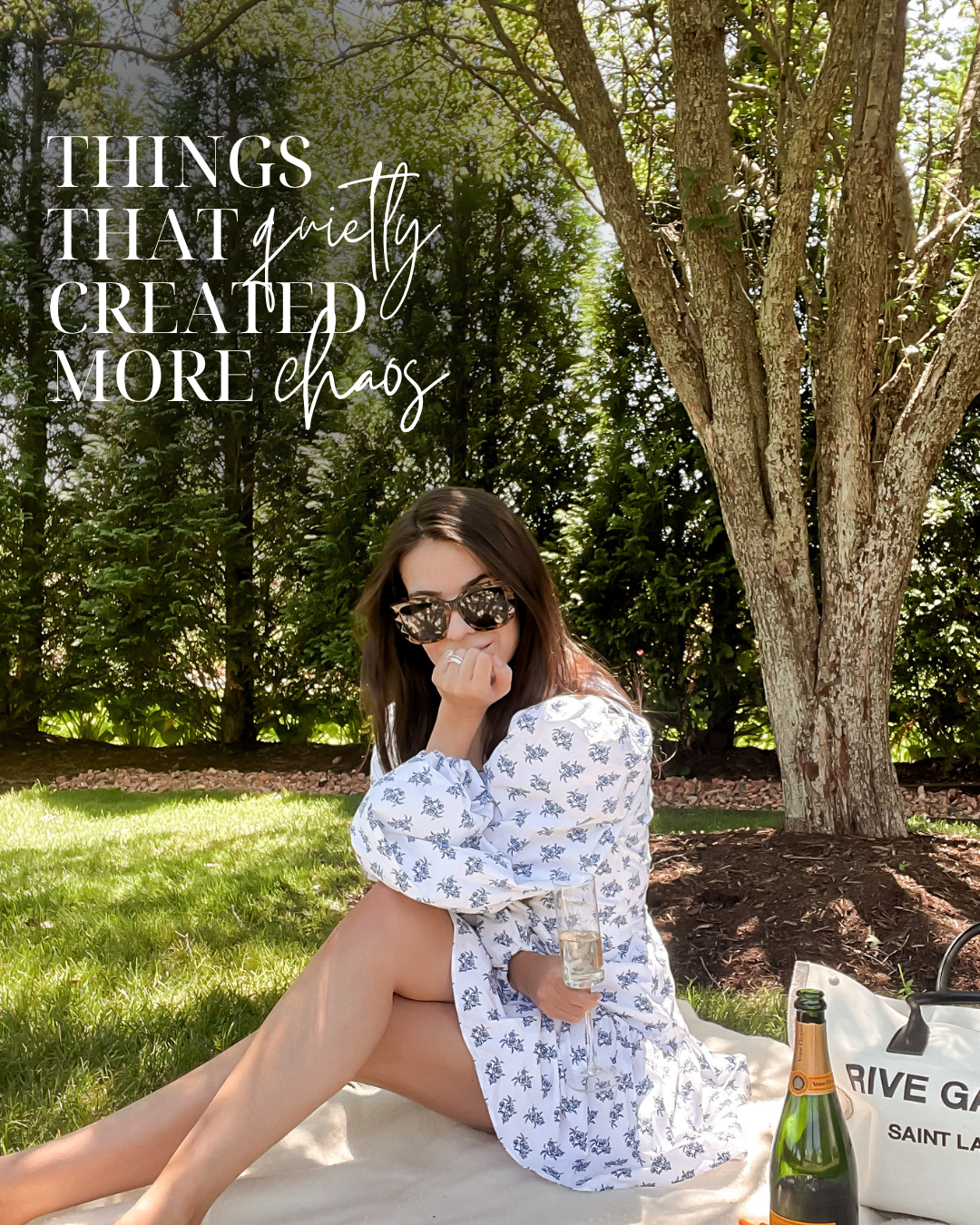
Finding balance is always challenging, but it wasn’t until I started paying attention to where I thought I was adding that I realized what I actually needed was subtraction.
A lot of these things looked positive on the surface. Fun, convenient, productive, social, aspirational, even “self-care” in some ways. And individually, none of them felt dramatic enough to question.
But together, they were quietly creating chaos.
More decisions to make. More money being spent. More overstimulation. More clutter. More pressure to keep up with routines, plans, trends, products, and expectations that didn’t necessarily make life better, they just made it fuller.
And eventually I realized that while life wasn’t going to become less busy, it could function better with a little more structure and a little less working against me.
Buying outfits for every occasion
I used to buy very specifically for events, dinners, concerts, weekends, trips, all of it. Not because my style was constantly changing, but because it felt like every occasion needed its own outfit.
Over time, I realized I was buying too much for the moment instead of for longevity. Pieces that photographed well or fit a very specific vibe, but didn’t necessarily integrate back into my actual wardrobe long term. And don’t get me wrong, if that moment calls for a wear it once moment, then that’s ok too, but it was the logistics, shopping and time that became the issue - not the clothes.
Now I shop much more responsibly and focus on pieces I know I’ll realistically wear repeatedly and in multiple ways. And for the occasions where I want something trend-driven, fun, or different, I lean much more on services like Rent the Runway and Vivrelle. Less pressure, money and honestly, more fun.
It still gives me the twist of fashion and getting dressed up without constantly consuming more or creating a closet full of pieces that only work once.
Trying every skincare product everyone else was using
At one point I had entirely too many skincare products. Too many steps, too many actives, too many things promising some kind of overnight transformation. A lot of it was being sent to me and while I’m grateful for it, I soon realized that there wasn’t a possible outcome to fit it all in.
Hundreds of products and the best formulas but somehow my skin looked worse.
I also finally stopped using makeup wipes after years of pretending they weren’t breaking me out when they absolutely were.
I think social media and beauty marketing can make it feel like everyone has a complicated routine, and if you’re not layering twelve products every night looking like a glazed donut, you’re somehow behind. But most of the time, my skin responds much better to consistency than complexity.
Now I use far fewer products, stick to what actually works for me, and my skin has honestly never looked better. Do we want a favorites post?
Thinking exhaustion meant I was productive
For years, I fully convinced myself I was “more creative at night.”
And sometimes I probably was. But I also think I was exhausted more often than I realized.
Late nights started feeling productive simply because they were quiet. Fewer emails, fewer expectations, fewer people needing things from you. But eventually I realized I wasn’t actually functioning better, I was just functioning alone.
Once I started prioritizing sleep and building an actual nighttime routine, everything shifted. My focus improved, my mood improved, my creativity improved, and honestly, so did my ability to handle stress.
Turns out being tired all the time wasn’t actually part of my personality and doesn’t equate to success.
Spontaneous date nights
I used to romanticize spontaneity a lot more than I realistically had the capacity for.
Last-minute dinner plans, squeezing in one more night out after a long work day, saying yes because it sounded fun in the moment. And sometimes it was. But other times it just left me wondering if having no plans would’ve been better.
I think there’s this idea that spontaneity automatically makes life more exciting, but I’ve realized I enjoy things much more when they actually fit into my life instead of disrupting it. Believe me, there is nothing I love more than trying a new restaurant or spending the evening in a booth with my husband and a bottle of wine, but we realized that it was more about the intention of making the plan than the actual date.
What if someone had a tough day at work? What if staying home and watching a movie felt more appealing in the moment? Changing plans led to potential disappointment, dismissed time and energy in planning, and, of course, the “where do you want to go to dinner?” question.
Now, it looks like a weekly date night where we both have the expectation and commitment ahead of time. We talk about where, when and details ahead of time and then show up where we need to. If time, location or date needs to change, then we do, but we both hold the commitment of date night without the spontaneity leading.
Saying yes to too much socially
I love dinners, events, spontaneous plans, date nights, trips, concerts, all of it. The Gemini that I am could spend all night out talking, dancing, and enjoying every second, but then kick myself when I get home wishing I hadn’t.
But I also realized that saying yes to everything started making me feel more drained than fulfilled.
Not because the plans themselves were bad, but because constantly being “on,” always going somewhere, or trying to fit everything in eventually starts catching up with you, especially while balancing work, relationships, routines, and everyday responsibilities.
Ironically, I enjoy the things I do go to much more now that I’m more selective about what actually deserves my energy. Everything compounds and nothing adds up faster than multiple social events a week.
Overcomplicating routines I realistically couldn’t maintain
This one took me longer to realize.
I think there’s so much pressure now to optimize every part of your life. The perfect morning routine, perfect workout split, perfect skincare routine, perfect supplement schedule, perfect productivity system.
And honestly, I think sometimes we create routines for an imaginary version of ourselves instead of our actual life. The Pinterest board of your life feeling. Some mornings it worked and I felt great about it, other times I was asking myself why am I doing this? Do I actually need this?
I realized I didn’t need more steps. I needed simpler ones that I could realistically maintain consistently, even during busy weeks. I then heard a tip about having a bare minimum routine and then a full routine. I was trying to hit the full routine every day when I needed to establish what the minimum bar was.
The full plan is extensive and sometimes overwhelming when you’re running behind, not feeling well, traveling, or adding in appointments.
Once I understood my nonnegotiable steps (the daily stoic and devotional) it became easier to feel like I had still accomplished something without the weight of the entire routine on me.
Letting convenience make too many decisions for me
This one sounds minor, but it changed more than I expected.
I realized how much time, money, and mental energy I was losing to random errands. A grocery run usually turned into buying things we didn’t actually need or were craving in the moment. A stop at Target somehow became another notebook, candle, or organizational product I convinced myself I needed and then it sat in a corner never being used.
And convenience worked the same way with food too. If I was tired, busy, overstimulated, or unprepared, the easiest option usually won and then we realized we’re eating out multiple times a week.
Now I rely much more on grocery pickup, delivery services, online ordering, and planning ahead just enough to remove some of those unnecessary decisions and errands. It helps keep us in the lane of only buying what we actually need.
It’s less stimulating, less impulsive, and honestly just keeps life moving more smoothly.
None of these things were ruining my life or that dramatic individually.
But together, they were adding friction everywhere else.
And I think that’s what I’ve realized most about adulthood, balance, and trying to manage a full life well. Usually it’s not one massive thing making everything feel overwhelming. It’s smaller habits, routines, purchases, expectations, and decisions stacking on top of each other quietly over time.
Life didn’t magically become less busy.
It just started functioning better once I simplified a few things and added structure where I actually needed it.