

Posts tagged marketing
The Things That Make Fast-Paced Work Feel Manageable

There’s a version of working in marketing that looks very polished from the outside. It’s very much like marketing itself; the glitzy, best aspects of the role, the fun events and perks. Fast-moving, creative, always something happening. And while that’s true, what makes it actually work day to day tends to be much simpler and much less sexy than people expect. It’s not a long list of tools or a perfectly optimized routine. It’s a handful of things that I come back to consistently because they make everything else easier to manage.

Not necessarily more productive in the traditional sense, but more clear, more focused, and a little more balanced in a role that isn’t always predictable. Below is a peek into a pretty crazy week in the life working in hopsitality marketing.

A Few Things I Actually Rely On

I don’t look at my phone for the first hour of my day

This has been a challenge for me, as a lot of my day-to-day responsibilities in work sit in the digital world. However, waking up and immediately being hit in the face with venue schedules, questions for the day, follow-ups from yesterday, or the to-do list ahead sets the tone for chaos - for me personally. Y’all know I’m a big proponent of the morning routine, and it has been essential for me to start each day level-headed, calm, and focused.

A notebook I use every day
I’ve tried to digitize this more than once, but I always come back to writing things down. Not everything needs to be captured, just what matters. Priorities for the day, notes from meetings, ideas that would otherwise get lost. Being organized in my thoughts, to do list, quick notes, and schedule is something that has, for me, usually had a tie to paper and physically writing them down. My calendar lives digitally as I gave up on physical planners years ago, but there is another lesson there. Know how you work and lean into what feels right.

Uniform dressing
This has made more of a difference than I expected it to. Getting dressed without having to figure it out every morning removes a layer of decision-making that I didn’t realize was adding up. It’s not about repetition; it’s about starting from something that already works. (I shared more on this in a previous post.) I also have been using Rent the Runway for years and love how it helps me plan outfits, provide staples that inform uniform dressing and helps me keep a strong edit on my my own closet.

Project Management Tools
I was introduced to project management tools early in my career in Chicago, and it was one of the first things that meaningfully changed how I worked day to day. I’m an advocate for Asana, which is what my team utilizes. In a field that can be open-ended, fast-paced, and highly creative, having a system creates structure where there otherwise wouldn’t be any.

It’s less about organization for the sake of it, and more about creating clarity. Process-oriented thinking allows us to move quickly without losing direction, and gives balance to work that can easily become reactive.

Using AI as a thinking partner
Not to replace the work, but to support it. Whether it’s organizing ideas, pressure-testing a concept, or getting out of a creative block, it’s become something I use daily. The value isn’t in having it think for you, it’s in helping you think more clearly.

Refinement has been a consistent theme for me lately, and AI has played a large role in that. From early-stage brainstorming to tightening copy, analyzing data, researching audiences, and building out campaign directions, it’s become a tool that allows me to move faster without sacrificing depth.

It’s still somewhat controversial, but there’s a lot of value in expanding your own thinking while allowing something else to handle the legwork. I’ve saved hours of time researching, become more informed within minutes, and challenged my own perspective in ways I wouldn’t have otherwise.

Books I actually reference
Not just reading for the sake of it, but returning to ideas that shape how I approach my work. The kind of books that influence taste, decision-making, and how you see things, not just tactics. In this post, I outline my favorite marketing books and highly recommend any of them. They’re the books that contain concepts I keep returning to, share with my team, and consistently use in the office.

What I Pay Attention To & CONSUME

One thing that’s made a bigger difference than I expected is how much I’m actually consuming the space I work in.

Not in an overwhelming way, but consistently enough that I’m aware of what’s happening, what’s working, and where things are going. That means paying attention across different channels, not just the ones I naturally gravitate toward. Social, brand campaigns, hospitality trends, music, culture, and even how people are interacting with spaces and experiences in real time. It’s less about keeping up and more about building context.

The more you see, the easier it is to recognize patterns. What feels fresh, what feels overdone, what actually resonates with people versus what just looks good on the surface. Over time, that starts to shape your instincts in a way that makes decisions feel more immediate and less forced. Especially in a role where things move quickly, that kind of awareness matters more than having the perfect answer.

Just as important as what I consume is what I don’t. Editing out content, noise, and inputs that don’t serve me has made a noticeable difference. I’m selective about what I follow, what I spend time on, and what I allow into my space. Protecting that, especially mentally, allows me to stay focused and operate at a level that feels consistent.

What Matters More Than Any Tool

All of this helps, but none of it replaces how you show up. If anything, it just supports it. There are a few things that have made a bigger difference than anything I’ve added.

Knowing what deserves your full attention
Not everything does. The faster you can recognize what actually matters in a given moment, the easier it is to move through everything else without feeling pulled in too many directions.

Being clear in your decisions
Indecision tends to create more work than the wrong decision does. The more you trust your judgment, the less time you spend reworking things that were already close.

Letting consistency do more of the work
You don’t need to approach everything as if it’s new. The more you can rely on what already works, whether that’s how you get dressed, how you structure your day, or how you approach your work, the easier everything becomes.


There isn’t one thing that makes a role like this work. It’s a combination of small decisions, repeated often enough that they start to feel automatic. The tools help, but they’re not the point. They just make it easier to show up the way you need to.

The Details That Change Everything

It’s never one thing. It’s everything working together.

There’s a difference between something that works and something that feels right. Most of the time, it isn’t one defining feature that creates that feeling. It’s a series of smaller decisions. Ones that don’t necessarily stand out on their own, but together, create something cohesive.

You don’t always notice them immediately. But you feel them.

The lighting is softer than expected. The music fits the room without competing with it. A space feels intentional, even if you can’t explain why. An outfit comes together without needing adjustment. Nothing is pulling too hard for attention. It’s subtle, but it changes everything.

We tend to look for the one thing that will make the difference. The right piece, the right plan, the right moment. But more often than not, it’s the accumulation of smaller details that creates the result we’re actually after. And when those details are considered consistently, things start to feel easier. Not effortless in the sense that nothing went into it, but effortless in the sense that everything has already been decided.

That’s where clarity comes from. It shows up in how you get dressed. Pieces that work together without needing to be rethought. Nothing competing, nothing slightly off. You’re comfortable and feel confident. It shows up in your environment. Spaces that feel aligned with how you want to live, not just how they look.

And it shows up in your time. Days that aren’t just full, but intentional. None of these things requires more. If anything, they require less. Less noise. Less overthinking. Less trying to force something into place.

The difference is in the details that remain. The ones that have been chosen carefully, repeated consistently, and refined just enough that everything else can fall into place around them.

What This Looks Like in Practice

It’s easy to talk about details in theory, but they matter most in the moments where things aren’t controlled. Especially in work that doesn’t follow the same rhythm every day. I shared a little day in the life video on my Instagram last night that showcases a view into what a day can look like working in hospitality.

Some days are structured. Others aren’t. Priorities shift, timelines move, and what you planned for the day isn’t always what it becomes. That’s where the smaller things start to matter more. Not as a way to control the day, but as a way to move through it.

Routines that don’t change. Decisions that have already been made. Boundaries around what gets your time and attention. They’re not rigid, but they’re consistent. And that consistency is what creates a sense of stability, even when everything else is moving. It’s not about having a perfect system, but about having something to return to.

I’ve learned I can’t control the day, but I know what works and what doesn’t for me.

A consistent start to the day; my morning routine is what anchors the entire day. Starting with consistency and clarity makes everything easier for me. How I approach things, my outlook on the day, the mood I’m in and the accountability to myself each morning.

Decisions made before I need them: uniform dressing helps eliminate the extra decisions and time. Having that figured out provides a structure I can fall back on. I don’t have to wonder if I’ll feel good in the outfit, if it fits properly or if I feel my best.

Time that isn’t already spoken for: Creating time for the things that make me feel creative, or time to think, time to not be in meetings, it’s all scheduled and thoughtful. It’s easy to jump straight to the next thing, but I’ve found the magic is in between when there is no pressure and we aren’t reacting.

Space that feels like I can think clearly: whether it is in my living room during my morning routine, my office space, or just a moment to reset, having a space that informs what you need your environment to be is something I can’t recommend enough.

Something to look forward to at the end of it: some non-negotiables happen nightly and provide that foundation, like dinner with my husband and time without our phones, but it can also be a glass of wine on the back deck, a concert or fun industry event.

None of it guarantees a perfect day. There are still moments that feel rushed, off, or completely out of sync. Soemtimes we take the L and pour another glass of wine, but having something consistent to come back to changes how everything else feels. It’s less about controlling the day and more about moving through it with clarity. Not everything works every time, but it works more often than it doesn’t. And most days, that’s enough.

14 Marketing Books that will Change the Way You Think (Even if You Aren’t in Marketing)
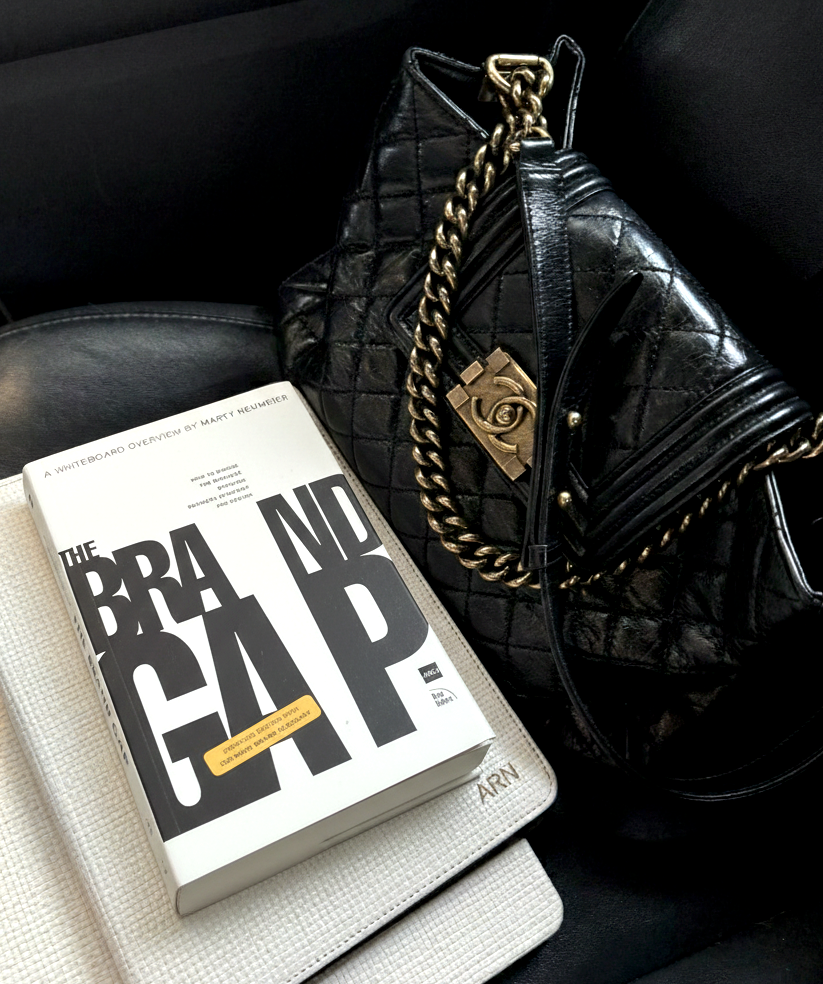
The brand gap book ontop of stacked ipad and computer in the front seat of a car with Chanel handbag

If you’ve ever asked someone in marketing, “How did you learn this?” the answer is almost never just school or a job title. It’s usually a mix of experience, mistakes, curiosity — and a handful of books that quietly shape how you think. I’m a big believer that marketing should be a group activity, and while I haven’t had the longest career, I’ve learned a lot from the network I’m grateful to be a part of and the books that taught those people a lot of what they know and have shared with me.

I’ve always believed that the best marketing isn’t really about marketing at all. It’s about people. About decision-making. About creativity under pressure. About how ideas land, spread, or fall flat. I’ve found the same to be true in the majority of the marketing books that sit on my bookshelf. Sure, they’re filled with best practices and marketing principles, but the true artform of marketing lies within the people that shape them, the systems that propel them, and the creativity we nurture.

Whether you work in marketing, want to work in marketing, or are simply looking for a more well-rounded understanding of how marketing principles show up in business and life, these are books I consistently recommend when someone asks me where to start. Think of this list as a bookshelf I’d happily point you toward if we were grabbing coffee together and you asked for a read that will reshape your perspective.

Creativity, Discipline & Doing the Work

One of my favorite conversations to have with people is about how creativity and artistic ability are not mutually exclusive. Some of the most creative people I know couldn’t draw a convincing stick figure, and some of the most artistic people I know have a hard time looking at problem-solving creatively. These books break the mold on the idea of creativity and how everyone has a level of creativity they can unlock and sharpen, no matter their profession or how well they can visualize something on paper.

These are for anyone who creates for a living, or is expected to show up with ideas even when inspiration is nowhere to be found.

The Accidental Creative: How to Be Brilliant at a Moment’s Notice by Todd Henry
This book reframes creativity as a responsibility, not a mood. It’s about building habits, systems, and clarity so you can deliver strong work consistently — especially when the pressure is on.

Creative Confidence by Tom Kelley and David Kelley
A reminder that creativity isn’t reserved for designers or artists. It focuses on confidence, experimentation, and empathy as skills anyone can build — and benefit from.

Brand, Strategy & Positioning

If you’ve ever wondered why some brands just make sense, and why others feel forgettable, these are essential reads. Being creative is an aspect of marketing, but without the formulas and systems that make it all work together, that big idea may never come to life or last the test of time to build brand loyalty.

The Brand Gap by Marty Neumeier
A foundational book that connects strategy and creativity in a simple, visual, and incredibly practical way. It’s one of those reads that permanently changes how you look at brands. Apologies in advance for how you will never be able to look at a marketing campaign without the Brand Gap lens again.

Juicing the Orange by Pat Fallon
This book challenges you to unapologetically think bigger, push against category norms, and create brand ideas that actually move people emotionally. And then it breaks that down and asks you to do it on a bigger scale. The best marketing ideas and brands are built from tension, sitting in the uncomfortable to find the comfortable, and breaking what already exists to find the true value. Marketing dies in complacency, and this book pushed me more than most to operate in that mindset regularly.

Positioning: The Battle for Your Mind by Al Ries and Jack Trout
An older classic that still holds up. It explains how brands win or lose in the mind — and why perception often matters more than product itself. The true win in marketing is convincing millions of people that a product that hundreds of other companies have is better than another, not because it is, but because the consumer perceives it to be. Ideally, you’re in a unicorn situation and marketing a one-of-a-kind, ca n’t-be-beaten product, but more often than not, the strategy is positioning rather than product.

Obviously Awesome by April Dunford
This modern take on positioning is instrumental in crowded markets. Clear, practical, and helpful for articulating what truly makes a brand different. This book takes positioning to the next level and breaks down why context, a specific target audience, and differentiation set brands apart from the crowded markets they are in.

Messaging, Storytelling & Making Ideas Stick

Messaging, Storytelling & Making Ideas Stick

These books focus on communication, how to say the right thing at the right time, clearly, without overcomplicating it, and even when silence is a stronger tool than the perfectly worded pitch. Every marketing campaign should include a story, but where the best campaigns set apart from others is when the team behind them gets granular about how it’s said, the visuals that accompany it, the voice sharing it, and the level of detail in every single one of those categories.

Made to Stick by Chip Heath and Dan Heath
A breakdown of why some ideas are memorable while others disappear. It introduces simple frameworks for clarity, relevance, and emotional impact. There’s a reason certain commercials, brands, and visuals stick with you, and this book gives you the cheat code to unlocking why they do. Spoiler, it’s usually the most clear, focused, and stripped down messaging that is remembered most.

Building a Story Brand by Donald Miller
A straightforward framework for simplifying brand messaging using storytelling principles. Especially helpful when you’re trying to clarify what you actually do. One of the biggest lessons I’ve learned in marketing? The customer is the main character, not the brand. You’ve already lost the plot if your main message is talking about you.

Everybody Writes by Ann Handley
A reminder that writing is a core business skill. Practical and approachable, especially for anyone creating content, emails, or digital communication. You don’t have to be a copywriter to nail the skillset of writing with clarity, tone, and connection.

Psychology, Behavior & Why People Say Yes

Understanding people is essential in marketing and in life. Why they do what they do, what they care about, and how to unlock that in marketing strategy to meet them where they are is a foundation for the best campaigns. While understanding your audience is a great tool for marketing, these books taught me a lot about people in general and how to work with them, build off ideas, and, even more importantly, they taught me a lot about myself.

Influence by Robert B. Cialdini
A classic for a reason. It breaks down the psychology behind persuasion and decision-making, and once you read it, you’ll start seeing these principles everywhere. Most people already have an answer in their minds before they even ask the question. They are influenced by what they consume, social proof, and invisible context clues around them, so most of the time, their mind has already decided for them.

Alchemy by Rory Sutherland
One of the most interesting books on this list. It challenges purely logical thinking and shows how emotion, culture, and perception drive behavior. We wouldn’t be human if we operated solely on logic, and the factors of how campaigns and products make us feel usually matter more than price, features, or efficiency.

Thinking, Fast and Slow by Daniel Kahneman
More dense, but incredibly impactful. It reshapes how you think about decisions, bias, and judgment well beyond marketing. A key takeaway from this book for me was about the notion that people are more motivated to avoid loss than to achieve gain, which has major implications for pricing, messaging, and how value is framed.

Growth, Modern Marketing & Competitive Advantage

For thinking beyond tactics, trends, and short-term wins. In today’s world, virality seems to be the goal. While growth, competitive advantage, and trends are aspects of that, brands that make the biggest impact are those that create longevity. The books below focus on driving attention, creating demand, and how to stand out in markets.

Contagious by Jonah Berger
Explores why certain ideas spread organically. Especially useful for understanding word-of-mouth, cultural relevance, and shareability. If you’re interested in social media marketing, influencer marketing, and content, this book touches on the aspects of identity, connectivity, perception, and the emotion that is needed to drive action rather than just bringing attention to something.

Blue Ocean Strategy by W. Chan Kim and Renée Mauborgne
A strategic lens on creating demand instead of fighting for attention in crowded markets. More business-focused, but incredibly valuable for marketing leaders. Many marketers are focused on beating their competitors, but the real marketers are focused on making them irrelevant because they’re creating new demand in a redefined space altogether.