
Early in my career, I found myself venting to a coworker after pouring everything into a campaign that had been met with skepticism from the very beginning. Behind the scenes, nearly every detail was questioned, and I was repeatedly told it wouldn't be successful. Yet when the campaign launched, and the team's response, sales performance, and results exceeded expectations, the conversation quickly shifted from whether it would work to that person taking credit.
After listening to me spiral for a bit, she offered a perspective that has stayed with me for more than a decade.
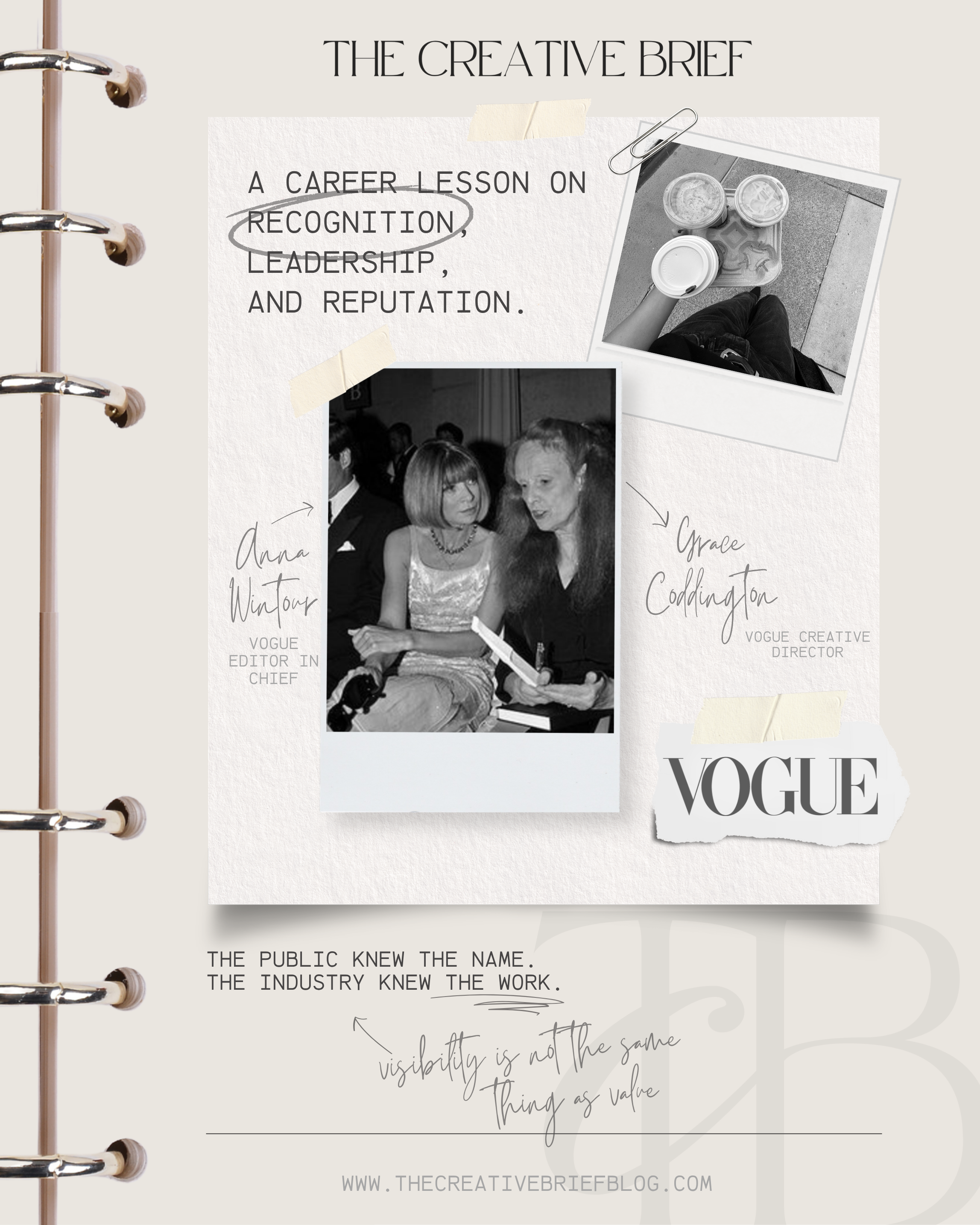
"Amanda, the best people in the business don't get recognition. You're not Anna Wintour, you're Grace Coddington. Look to the people who give the public figure recognition through their work. The real ones know they want to be Grace, not Anna."
For those who aren't fashion people, Anna Wintour is arguably one of the most recognizable names in publishing and fashion. As Editor-in-Chief of Vogue, she became the public face of an entire era of fashion media. Grace Coddington, Vogue's longtime Creative Director, was responsible for many of the iconic editorial stories and visual moments that helped define that era. Anna became the symbol. Grace helped create the substance behind it.
And to be clear, I took this comparison as an enormous compliment.
Grace is widely regarded as one of the most brilliant creative minds in fashion. Her influence shaped generations of photographers, stylists, editors, and creatives. Within the industry, her contributions weren't hidden at all. In many ways, they were legendary. What made the comparison interesting wasn't the implication that Grace mattered less. It was the opposite. My coworker was pointing out that some of the most influential people in any field aren't necessarily the most visible.
At the time, however, I don't think I fully understood what she meant.
Like many people early in their careers, I was still operating under the assumption that visibility and success were closely connected. If your work was valuable, people would know about it. If your contributions mattered, they would be acknowledged. If you did enough good work, recognition would naturally follow. The older I get, the more I've realized how incomplete that equation is.
Visibility and value are often related, but they are not the same thing.
In almost every industry, there are people whose names carry significant public recognition and people whose expertise quietly shapes the outcome. Sometimes they're the same person. Often they're not. The further I've progressed in my career, the more I've realized that the people closest to the work almost always know the difference.
They know who developed the strategy. They know who solved the problem. They know who stayed late, navigated the obstacles, managed the relationships, and carried the project across the finish line. While recognition may not always land where it should publicly, credibility has a way of finding the right audience. That's because credibility can't be manufactured the way visibility can.
Visibility can come from a title, a platform, proximity, timing, or simply being the person standing at the front of the room. Credibility is different. Credibility is earned through consistency. It accumulates over the years. It grows every time you deliver, every time you solve a problem, every time you become the person others trust when the stakes are high.
In hindsight, I think that's what my coworker was really trying to teach me. Not that recognition doesn't matter, but that there are different kinds of recognition, and some are far more valuable than others.
As I moved into leadership positions, I've found myself thinking about this lesson from the opposite perspective as well. The best leaders I've worked with never seemed particularly concerned about collecting credit. What distinguished them wasn't humility for humility's sake. It was that they understood the work deeply enough to know exactly where the credit belonged.
There's a difference between acknowledging a team and understanding a team.
Some leaders operate at such a distance from execution that every outcome becomes a summary. They know whether something worked, but not necessarily how it worked. Others remain curious. They ask questions. They learn the details. They understand both the strategy and the execution because they genuinely respect the expertise required to produce great work.
As a result, they're able to recognize contributions with specificity. They know whose idea shifted the direction of a project. They know who solved the problem no one else could solve. They know who quietly held everything together behind the scenes. Those leaders become trusted because people feel seen.
I've also noticed that the most respected leaders rarely seem threatened by someone else's contribution or success. In fact, they actively create opportunities for it to be visible. They mention names in meetings. They advocate for people when they aren't in the room. They share ownership. They create opportunities. They understand that leadership is not about being the smartest person in the room but about building a room full of smart people and ensuring they have the opportunity to succeed.
Ironically, those are often the leaders who earn the deepest respect themselves. Not because they demanded it, but because they created an environment where great work could thrive.
Looking back, I don't think my coworker was telling me to become comfortable with being overlooked. I think she was encouraging me to pay attention to a different scoreboard altogether.
The goal isn't invisibility. The goal isn't martyrdom. The goal isn't convincing yourself that recognition doesn't matter. The goal is to build a reputation so strong that the people who understand the work understand your contribution. And if you're fortunate enough to lead others, to create the kind of environment where that recognition extends beyond you.
The public knew Anna. The fashion industry knew Grace.
And the older I get, the more I understand why that distinction matters.